
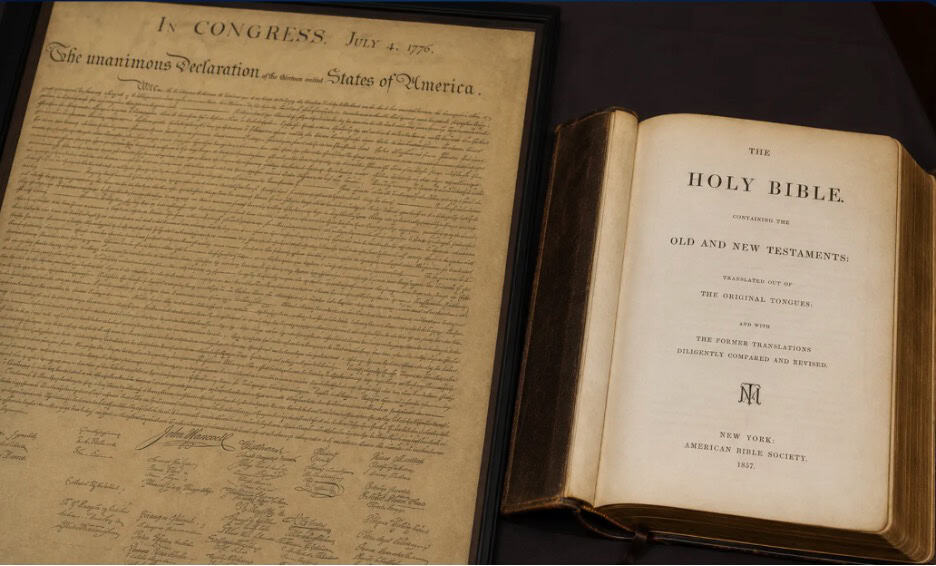
An earlier version of this piece appears as a chapter in the new book Still, We Hold: Reflections on The Spirit of 1776, by Centennial Institute of Colorado Christian University
This spring I went to look at it again.
On a trip to Washington D.C., I carved out time for another pilgrimage to the National Archives, where America’s most important national documents are enshrined—especially the Declaration of Independence.
The first time I saw it was as a college student in 1976 during America’s bicentennial celebration. I have seen it many times since. Each visit has affected me differently. But this time, with America’s 250th birthday upon us, I found myself asking a deeper question: What kind of world did this document come from?
The Declaration is significant not only because it announced America’s break from Britain and the birth of a new nation, but also because it gave that break a moral, philosophical, and theological argument. It did not merely say, “We want independence.” It said, in effect, “There are truths about God, human nature, rights, government, and justice that make independence necessary.”
Many Americans attribute this extraordinary charter of freedom to “the genius of Jefferson,” or “the genius of the Founders,” or “the genius of America.” Others reduce the Declaration to a product of secular Enlightenment rationalism. Both approaches miss an essential part of the story.
One major influence in the making of the Declaration is too often ignored: the Bible.
This is not to deny other influences. Of course, classical political thought mattered. English constitutionalism mattered. Locke mattered. British imperial overreach mattered. But these alone do not explain the moral and spiritual world of the eighteenth-century America, a society steeped in Scripture.
America has two official founding documents: the Declaration of Independence and the Constitution. The first gave the new nation its founding principles. The second gave it its governing frame. But we seldom acknowledge that behind them stood another text—older, deeper, more widely read, more frequently cited, and more formative than either.
The Bible was not America’s formal founding charter. It was not ratified by the states or placed beside the Declaration and Constitution as a legal document. Nevertheless, it was one of the deepest moral and spiritual sources behind the American founding. It shaped the people who shaped the nation.
It was read in homes, heard in churches, taught in schools, quoted in political sermons, echoed in pamphlets, and assumed in public discourse. It shaped how Americans thought about authority and accountability, freedom and law, rights and duties, sin and virtue, judgment and providence.
Recent scholarship has made this increasingly difficult to ignore. Scholars such as Donald Lutz, Carl J. Richard, Daniel Dreisbach, and Mark Noll, along with Eran Shalev, James Byrd, David Dalin, and Thomas Kidd have shown the Bible’s expansive influence on the public culture of the founding era. Daniel Dreisbach puts it plainly: “The Bible, more than any other written word, informed the world of the founding fathers.”[1]
For this reason, I contend that the Bible may fairly be called America’s unofficial third founding document.
A Bible-Shaped People
To understand the Declaration, we must first understand the people who produced it.
Most of the earliest European colonists in North America identified as Christians of one kind or another. New England was largely settled by Puritans. Virginia and much of the South were Anglican. The middle colonies included Presbyterians, Dutch Reformed, Lutherans, Quakers Baptists, Anglicans, Catholics and others. The Southwest was shaped by Spanish colonization and Catholic missions. Indeed, Romand Catholics first brought the Bible to the New World.
For roughly the first two centuries of European settlement, the dominant public culture in North America was Christian, not secular. In the thirteen colonies it was predominantly Protestant. In 1776, approximately 98 percent of colonists were Protestant, 2 percent were Roman Catholic, along with a small Jewish population.[2] Nine of the thirteen colonies had established churches.[3]
The overwhelming majority of the signers were publicly affiliated with Christian churches. That affiliation should not be equated automatically with personal doctrinal orthodoxy. Several leading Founders participated in Christian churches and practices while rejecting historic Trinitarian doctrine. Nevertheless, they were all deeply influenced by the Bible and by a Bible-shaped culture.
In seventeenth and eighteenth-century America, the Bible was the most familiar and accessible book in the colonies. Its dominant presence created a striking cultural unity. It provided a shared language, a common store of images, and a moral grammar recognizable to most Americans of that generation. It was quoted not only by ministers, but by pamphleteers, lawyers, educators, politicians, and revolutionaries. Even Thomas Paine, later openly hostile to orthodox Christianity, assumed that his readers would understand biblical language and imagery.
Dreisbach writes that eighteenth-century Americans “lived in a culture shaped by Christianity and its sacred text.”[4] Biblical phrases and allusions often appeared without quotation marks because the audience recognized them instinctively. The Founders’ many quotations and allusions confirm that they knew the Bible well. Its language and themes liberally seasoned their rhetoric.
Donald S. Lutz’s well-known survey of American political literature form 1760-1805 reached a similar conclusion. He found that the Bible was cited more frequently than any other source.[5] Deuteronomy alone was cited more often than all of Locke’s writings combined. The apostle Paul was quoted about as often as major secular authorities such as Montesquieu and Blackstone.[6] Lutz demonstrates that the Bible was the most important religious—and political—text of the era.
Again, this does not make Locke, Montesquieu, Blackstone, classical republicanism, and English common law unimportant. It does mean that the Bible’s influence was deep.
This was especially true in Protestant culture. The Reformation had emphasized literacy so that ordinary people could read Scripture for themselves. A population formed by Scripture and biblical morality was thought essential for self-government.
So when Americans argued about liberty, tyranny, authority, representation, rights, law, and resistance, they did so in a public culture already formed by the Bible.
Again, this does not mean that everyone who read the Bible believed it as the Word of God. Some did not. Nor did everyone interpret it the same way. Loyalists and patriots argued from it differently. But Scripture shaped the vocabulary, moral assumptions and political imagination of the founding generation in ways that cannot responsibly be ignored. The Bible contributed a pre-political understanding which underlie both the Declaration and the Constitution—answering questions such as: What is a human? How should we understand human nature? Is there a moral order? What is law? What is the nature of freedom, etc..
The Bible and Republican Self-Government
The founding generation believed that republican self-government required virtue. If people were to govern themselves, they had to be capable of self-restraint. Liberty required moral formation.
Their logic was straightforward: republican government requires self-government; self-government requires virtue; the Bible provides the deepest foundation for virtue; therefore, biblical knowledge is essential for ordered liberty.
This is why the Bible was so often linked with education. A republic could not be sustained by law alone. It required citizens formed in habits of truthfulness, responsibility, self-command, duty, reverence, and justice. A people unable to govern their own appetites would eventually be governed by someone else.
This conviction helps explain early national efforts to make the Bible widely available. During the Revolution, when the embargo of British goods made it difficult to import English Bibles, printer Robert Aitken appealed to Congress for support in publishing “a neat edition of the Holy Scriptures for the use of schools.”[7] In 1782, Congress recommended his American edition. This did not establish Christianity as a national church, but it shows that Congress did not regard the Bible as irrelevant to the public good.
Similarly, the Northwest Ordinance of 1787 declared: “Religion, morality, and knowledge being necessary to good government and the happiness of mankind, schools and the means of education shall forever be encouraged.”[8] Now, the Bible is not named in that sentence, but in the overwhelmingly Protestant culture of the day, “religion” and “morality” would have been understood in close connection with biblical teaching.
Again, the point is not that the United States was founded as a church. It was not. Nor is the point that the Constitution created a confessional state. It did not. The point is that the moral ecology of the founding was deeply Bible-influenced. The Declaration emerged from that ecology.
The Declaration’s Theological Framework
What, then of the Declaration itself?
The Declaration is not a sermon. It does not mention Christ, sin, redemption, the church, or even the Bible. Yet it is deeply theological. It makes four explicit affirmations reflecting Scripture. God is represented as lawgiver, creator, judge and providential sustainer.
First, the Declaration appeals to God as lawgiver. It opens by referring to “the Laws of Nature and of Nature’s God.” The colonies are not merely asserting a vague political sentiment. They are appealing to a law higher than king or Parliament.
The phrase belongs partly to the language of natural law. But it also echoes the biblical teaching that human rulers are not absolute. Kings are accountable to God. In Deuteronomy 17, Israel’s king is commanded not to exalt himself above his brothers, but to submit to God’s law. Throughout Scripture, rulers are judged by a moral order above themselves.
The Declaration’s opening claim assumes that political authority is accountable to a higher law and a divine lawgiver. No king, parliament, congress, court, or state is ultimate.
Second, the Declaration affirms God as creator. Human beings, it says, “are endowed by their Creator with certain unalienable Rights.”
That phrase is crucial. Rights are not gifts from government. They are grounded in creation. Government exists to recognize and secure them.
Again, this language is not a direct quotation from Scripture. It also reflects natural law theory. But it echoes Genesis 1.26-27, where human beings are made in the image of God. Because humans belong first to God, they do not belong absolutely to the state.
This is why the Declaration’s claim that “all men are created equal” is so powerful. It was tragically compromised by slavery. Yet the principle itself provided a standard by which America would later be judged. Human equality was not grounded in class, royal favor, race, strength, wealth, or usefulness. It was grounded in creation.
Third, the Declaration appeals to God as judge. In its conclusion, the signers appeal “to the Supreme Judge of the world” for the rectitude of their intentions.
This is a sobering reference. The signers are not merely accusing King George III. They are placing their own cause before God. Their motives, grievances, and actions are subject to divine scrutiny.
This reflects the biblical truth that God is the judge of all the earth. Psalm 9 says the Lord “has established his throne for justice, and he judges the world with righteousness.” Paul tells the Athenians that God “has fixed a day on which he will judge the world in righteousness.”
The American Revolution, as the Declaration frames it, was not anarchical. It was a moral appeal made under the judgment of God. The signers were saying, not just that they opposed tyranny, but that God himself judges tyranny, injustice and the abuse of power.
Fourth, the Declaration affirms God’s providence. It ends with these words: “For the support of the Declaration, with a firm reliance on the protection of divine Providence, me mutually pledge to each other our Lives, our Fortunes and our sacred Honor.”
The signers were pledging everything. They were defying the most powerful empire on earth. Yet they acted with confidence in “the protection of divine Providence.”
Belief in providence was a common public assumption of the founding era. The founders, including the least orthodox among them, believed in a God who ruled over men and nations. True, they did not all mean exactly the same thing by providence. Some understood it in orthodox Christian terms; others in more general theistic terms. But they did not view history as random, secular, or morally autonomous. Nations stood under God’s rule.[9]
The Declaration therefore presents a world governed by higher law and a Creator who judges men and nations and guides history. Plainly, this is not a secular document in the modern sense. Nor is it an explicit Christian confession. But it is theistic and moral. Its truths were “self-evident” in the sense that they were regarded as broadly accessible through nature, conscience, Scripture, and the inherited Christian moral order of the West.
Resistance Theology and Ordered Liberty
Beyond these four explicit references to God, the Declaration also reflects biblical assumptions about resistance and liberty.
The Declaration reflects a resistance theology that colonial Protestants inherited from the Reformation, but which has roots in Scripture. This theology held that lawful resistance to a magistrate can sometimes be justified.
Generally, the Bible teaches obedience to civil authority, as in Romans 13, where Paul says governing authorities are instituted by God for our good. But rulers are not absolute. They are accountable to God’s law. Civil governments can be tyrannical, even beastly, when they oppose God and abuse people. At that point, the scriptural principle becomes: “We must obey God rather than man.” And, as Calvin argued in his doctrine of the lesser magistrate, lawful authorities may restrain tyrannical rulers and resist them.[10]
This theology was deeply lodged in the minds of the enormous stream of Scots and Scots-Irish who immigrated to the colonies in the 1700s (not to mention other kinds of Calvinists). They and their ancestors embraced this theology in the British and Scottish upheavals between the 1600s and the mid 1700s.
The Declaration reflects this theology not by quoting the Bible directly, but by expressing a familiar train of thought. It appeals to a law above the king. It defines government’s purpose as securing rights. It says tyrannical governments can forfeit political legitimacy. When they do, “it is the Right of the People to alter or to abolish it.” It adds that resistance must be justified by a “long train of abuses and usurpations.” It then charges the King of England with “absolute Tyranny.”
It is no accident that Benjamin Franklin adopted the motto “Rebellion to tyrants is obedience to God” when proposing his design for the Great Seal of the United States. Nor is it incidental that his design depicted Moses standing at the Red Sea while Pharaoh was overwhelmed. Franklin and other Founders understood their plight in light of Exodus.
The Declaration also reflected biblical assumptions about ordered liberty.
The call for independence was not a summons to freedom apart from God, but to freedom under God. In that sense, it was a declaration of dependence. Its charter of liberty was not an anthem of radical autonomy or expressive individualism. It assumed a moral universe in which liberty is ordered by truth, restrained by virtue, and accountable to the Creator who endows human beings with rights.
In Exodus, God liberates Israel from Pharaoh, but that liberation leads to a Sinai, covenant, commandments, and moral responsibility. Freedom from bondage is not freedom from God.
True freedom in the Bible is not lawlessness. It is not the anarchic freedom of the book of Judges, where “everyone did what was right in his own eyes.” Rather, it is freedom under God, ordered by truth, duty, virtue and law.
What Kind of Revolution?
In its conception of liberty, the American Revolution differed significantly from the later French Revolution.
The American War for Independence was a revolt against King Geoge III and British imperial overreach. It was not a revolt against God, religion, or Christianity. The French Revolution, especially as it radicalized, became aggressively anticlerical and openly hostile to Christianity. Notre-Dame Cathedral was famously transformed into a “Temple of Reason” in 1793.
The American Revolution, by contrast, did not seek to overthrow religion. It eventually produced the disestablishment of a national church as well as the protection of religious liberty. But it did not seek the secularization of public life in the modern sense. The Founders separated church and state at the federal level. They did not imagine a separation of God and public life.
That distinction matters. The Declaration’s theology is broad, not sectarian. It does not establish a denomination. But neither does it present a godless vision of liberty. It assumes that nations, governments, rulers, and peoples stand under God’s moral order. That understanding was also shaped by the Bible.
Founders on the Bible
We also have personal testimony from leading figures of the founding generation about the Bible’s public significance.
Banjamin Rush, physician, educator, signer of the Declaration, and advocate for Bible reading in schools, wrote: “I maintain that there is no book of its size in the whole world, that contains half so much useful knowledge for the government of the states, or the direction of the affairs of individuals as the Bible.” [11]
John Adams wrote to Thomas Jefferson in 1813: “The Bible is the best book in the World. It contains more of my little philosophy than all the libraries I have seen.”[12]
Samuel Adams wrote that the rights of the colonists could be best understood by “carefully studying the institutes of the great Lawgiver and head of the Christian Church,” found in the New Testament.[13]
George Washington’s public religious vocabulary was often reverent but nonspecific. Yet in his 1783 Circular Letter to the States, he spoke of “the pure and benign light of Revelation” and its “meliorating influence on mankind.” By “Revelation,” Washington most certainly meant divine revelation, and in the public context of his day, specifically the Bible. He was not treating revelation as obsolete or merely private. He saw it as a civilizational blessing.[14]
America’s Unofficial Third Founding Document
Taking all this together, one begins to grasp the extraordinary influence the Bible had on the Declaration and the American founding.
Historian Mark Noll has referred to early America as a “Bible civilization,” because Scripture supplied so much of the moral grammar and spiritual framework of the culture. The Bible, he says, “was the central text of early America.”[15]
In his magisterial two-volume study of the Bible in American life, Noll makes an even larger assertion. He writes, “It is no exaggeration to claim that the Bible has been—and by far—the single most widely read text, distributed object, and cited or referenced book in all of American history.”[16]
The claim is extraordinary, but recent scholarship confirms its force in the colonial and founding eras. The Bible’s influence on the American founding cannot be dismissed. It is not the whole story. But it is indispensable to the story.
This is why I contend that the Bible is America’s unofficial third founding document.
It was not America’s formal charter. But it was one of America’s most formative texts. In that sense, it is not third in importance. It is third only in the order of our public recognition.
The Declaration gave America its founding principles. The Constitution gave America its governing structure. But the Bible helped form the moral world in which those documents were conceived.
Returning to the Sources at 250
This entire year, as America celebrates its 250th birthday, we have a rare opportunity for national reflection and renewal.
But renewal requires memory. A people cannot understand itself if it forgets the sources that shaped it. The old Renaissance cry was ad fontes—back to the sources. For Americans, that should mean returning to the Declaration and the Constitution. But it must also mean returning to the older source that so profoundly shaped early American minds and hearts: the Bible.
If we celebrate the Declaration in isolation, we will never understand it. If we praise it merely as the product of our own genius, we will slide into national arrogance. And if we detach it from the moral and theological world that gave it birth, we should not expect the renewal we so desperately need.
Americans still live off of biblical phrases, assumptions, images, and moral categories, even when they no longer know their source. We speak of human dignity but forget creation. We invoke rights but forget duties. We praise liberty but detach it from any moral order. We demand justice by forget the Judge of all the earth. Our former Bible-shaped pre-political understanding has seriously eroded and must be strengthened.
To address our nation’s biblical illiteracy, the church must first address its own. The problem is not merely “out there.” It is in our pews, youth groups, homes, Christian schools, and colleges. I see it in every incoming class at our Christian university. Many students arrive with sincerity, intelligence, and good intentions, but without a solid knowledge of the Bible. They know fragments, but not the whole.
If Christians are to bear witness in this moment, they must recover a deeper knowledge of Scripture—not simply favorite verses, but the storyline of the Bible, the law of God, the gospel of Christ, a biblical worldview, and the wisdom needed for faithful citizenship. If the church is to withstand the confusions of our age, it will require a serious renewal of Bible teaching, preaching and catechesis.
Beyond this, our wider culture must also rediscover the historical significance of the Bible. Along with renewed civics education, I believe that the Bible should be reintroduced into our K-12 schools and universities as a primary source of American and Western civilization. I am not suggesting that public schools teach it devotionally, or that civics classes become Sunday School classes. But students cannot adequately understand the Declaration, the Founders, the Constitution, abolitionism, civil rights, American literature, or the moral vocabulary of the nation if they are never taught the book that so deeply shaped them.
They should also learn honestly where Americans violated biblical truth: in slavery, injustice toward Native peoples, racial discrimination, and other national failures. To teach the Bible’s influence is not to baptize every American action. It is to recover the moral standard by which America itself has often been judged.
America’s school children should certainly learn the Declaration. They should learn the Constitution. They should visit the National Archives to see these documents for themselves. But they should also learn about the book that shaped the moral world behind them both, and why the Founders believed religion, morality, and biblical knowledge were essential to self-government and human happiness.
It is time to remember, recover and renew.
[1] Daniel L. Dreisbach, Reading the Bible with the Founding Fathers (New York: Oxford University Press, 2017), 25.
[2] Barry A Kosmin and Seymour P Lachman, One Nation Under God: Religion in Contemporary American Society (New York: Harmony Books, 1993), 28-29.
[3] Historians usually count nine that had established churches, even though New York at the time only had established churches in four of its fourteen counties. So technically it had partial establishment.
[4] Daniel L. Dreisbach, Reading the Bible with the Founding Fathers, p. 5.
[5] Donald S. Lutz, The Origins of American Constitutionalism (Baton Rouge: Louisiana State University Press, 1988), 140.
[6] Donald S. Lutz, The Origins of American Constitutionalism, 66.
[7] Daniel L Dreisbach, Reading the Bible with the Founding Fathers, 35.
[8] Northwest Ordinance of 1787, art. 3, quoted in American Heritage: A Reader, ed. Hillsdale College History Faculty (Hillsdale, Michigan: Hillsdale College Press, 2011), 141.
[9] On the Declaration’s religious language and the founding-era use of biblical and providential categories, see Mark A. Noll, In the Beginning Was the Word: The Bible in American Public Life, 1492–1783 (New York: Oxford University Press, 2016), 313.
[10] John Calvin, Institutes of the Christian Religion, ed. John T. McNeill, trans. Ford Lewis Battles, 2 vols., Library of Christian Classics 20–21 (Philadelphia: Westminster Press, 1960), 4.20.31.
[11] Benjamin Rush, A Plan for the Establishment of Public Schools and the Diffusion of Knowledge in Pennsylvania; to Which Are Added, Thoughts upon the Mode of Education Proper in a Republic. Addressed to the Legislature and Citizens of the State (Philadelphia: Thomas Dobson, 1786), 19.
[12] John Adams to Thomas Jefferson, December 25, 1813, in The Works of John Adams, Second President of the United States, ed. Charles Francis Adams, vol. 10 (Boston: Little, Brown and Company, 1856), 85.
[13][13] Samuel Adams, “The Rights of the Colonists,” November 20, 1772, in The Founders’ Constitution (University of Chicago Press), document 3, “The Rights of the Colonists as Christians.”
[14] Washington, George. “Circular Letter to the States,” June 8, 1783. In The Writings of George Washington from the Original Manuscript Sources, 1745–1799. Edited by John C. Fitzpatrick. Vol. 26, 483–496. Washington, DC: United States Government Printing Office, 1938.
[15] Mark A. Noll, America’s Book: The Rise and Decline of a Bible Civilization, 1794–1911 (New York: Oxford University Press, 2022), 99–114.
[16] Mark A. Noll, In the Beginning Was the Word: The Bible in American Public Life, 1492–1783 (New York: Oxford University Press, 2016), 1.
1 Comment
This is terrific. It is a reminder that the God of the universe SPOKE life and ideal character traits into His book for the generations. . He also WROTE them on stone with his finger and gave to MOSES as an epistle for the ages. Dr. Sweeting’s scholarship must be shared both far and widely.