Originally published at the Denver Gazette on May 13, 2026.
It’s that season again. Graduation exercises are now upon us, that scholastic rite of Spring happening all over the country. Once again, we’ll hear another torrent of cliched advice being rolled out by celebrity commencement speakers for the Class of 2026.
Please tell me why this annual exercise has become so predictably banal? Why is the enormity of this important life transition celebrated with such shallow platitudes from accomplished people (who are usually paid a lot of money and given an honorary degree)? They inevitably say things like: “Follow your passion,” “be yourself,” “love yourself,” “accept who you are,” “go for it,” “bloom where you are planted,” “overcome adversity,” “wear sunscreen, etc..”
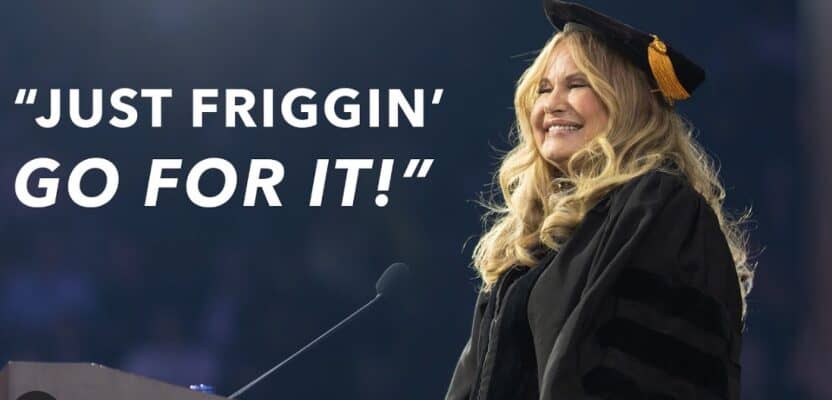
One thinks of Henry Winkler’s advice to Georgetown University grads last year to “avoid negativity,” or Jennifer Coolidge telling graduates of Emmerson College to embrace “unattainable possibilities,” and “just friggin’ go for it.” And then there is Kermit the Frog who appeared last year at the University of Maryland telling graduates to “leap together!”
Why does this keep happening? Lots of reasons: There is the fear of being politically incorrect and offending the audience. Administrators don’t want controversy. There is the fear of going too deep because, well, these are only….college graduates. So don’t provoke thought—just inspire. The audience is not hungry for something solid.
But beyond these reasons, there is something deeper. Many of our universities are steeped in the radical subjectivism of pomo-culture and the conviction that there is no objectivity, no wisdom, or meaning to life. Hence, we must impose our own. Then end result is the triumph of banality over substance, triteness over truth telling, political correctness over courage.
I will not give a commencement speech this year. But if I did give one, my speech would revolve around this simple theme: get wisdom.
These words come from the Biblical book of Proverbs, often largely attributed to King Solomon—a book used in both the formal education of an ancient king’s court, as well as family training. Proverbs is classic wisdom literature.
Our world desperately needs wisdom. Our political leaders need it. Judges need it. Corporate leaders need it. Families need it. University heads need it. Perhaps that is why Proverbs contains this imperative to “get wisdom.” The truth is, we all desperately need it—especially graduates of the Class of 2026 who are about to enter a wobbly “knowledge economy” at the beginning of a massive AI disruption.
Wisdom is not mere knowledge or information. The world is now overwhelmed by a tsunami of data. Knowledge production has grown exponentially, doubling every two years. We are awash in terabytes, petabytes, exabytes, zettabytes, and soon approaching yottabytes.
All the way back in 1934, poet T.S. Eliot poignantly asked in his poem Choruses from the Rock, “Where is the wisdom we have lost in knowledge, where is the knowledge we have lost in information?”
Wisdom is not AI content either. Machine intelligence does not dispense wisdom, because it has no real world experience. It can only summarize the wisdom of others.
In Proverbs, wisdom is not simply distilled general truths. It is something deeper—the ability to discern the natural and moral order of the world as it is—the things that do not change. It is the ability to discern reality (and not “my reality” and “your reality,” but objective Reality, capital R). It is a knowledge of God’s world, his creation order, and fitting into it. Yes, I am well aware that this very idea will get me eliminated from most American university lists of potential commencement speakers. Which simply highlights the problem about which I write!
How does a graduate get wisdom? This next paragraph would also be forbidden at many of our universities.
Wisdom, according the book of Proverbs, begins with the “fear of the Lord,” (Proverbs 1.7), a knowledge of God—reverence and respect for Him. Wisdom is the ability to discern permanent things, foundational things which do not change. It is increased by studying the past and the words of the wise people who have gone on before us. This would include the study of history, great literature, human letters, and great lives. Wisdom will only come when we are teachable—“with humility comes wisdom,” (Prov 11.12). It comes by hanging out with wise people—“He who walks with the wise grows wise,” (Proverbs 13.20).
Proverbs also has a descriptive term for those who despise all these things I’ve just mentioned as well as institutions that forbid them—“folly.” They are educated fools, out of sync with reality.
This is why we get too many cliched commencement addresses with trite advice.
In 2024, Melinda Gates’s top career advice for Stanford graduates was “embrace uncertainty.” My top career advice to graduates would be radically different. I would tell them to “embrace wisdom.” Discern and embrace those things which never change. They will be a guiding compass for you as you navigate all the things that do change in life and in the coming disruption. For, as Proverbs says, “wisdom is more precious than rubies, and nothing you desire can compare with her.” (Proverbs 8.11).
Dr. Donald Sweeting (@DSweeting) American educator, former president and chancellor of Colorado Christian University.