
Originally published at The Denver Gazette on May 31, 2026.
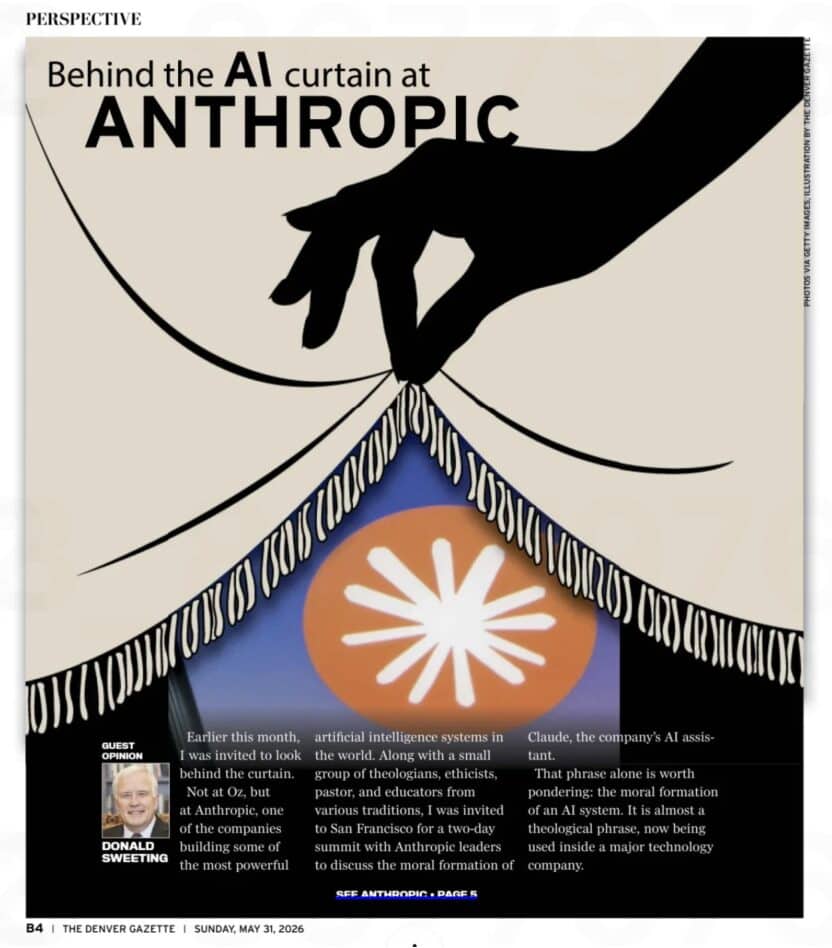
Earlier this month, I was invited to look behind the curtain.
Not at Oz, but at Anthropic, one of the companies building some of the most powerful artificial intelligence systems in the world. Along with a small group of theologians, ethicists, pastor, and educators from various traditions, I was invited to San Francisco for a two-day summit with Anthropic leaders to discuss the moral formation of Claude, the company’s AI assistant.
That phrase alone is worth pondering: the moral formation of an AI system. It is almost a theological phrase, now being used inside a major technology company.
Anthropic was not seeking our endorsement for a product or a policy agenda. The conversation felt sincere. They gave us a foundational overview of AI systems and their challenges, asked serious questions, and listened carefully. They seemed to understand that the issues before them are not merely technical. They are moral, philosophical, anthropological, and even theological.
I went into the meeting with many questions. Who are these people? Do they ever think deeply about the moral and philosophical implications of AI? Do they have a view of human dignity? Are they looking beyond technical advancement, market share, and corporate profit? What do they believe they are building?
I expected to be impressed. I was.
I did not find reckless technologists drunk on their own power. I found thoughtful, serious morally alert people trying to shape one of the most consequential technologies in human history. They were candid about the risks of what they are building, but also about its immense possibilities. They are committed to building a safer AI and to harnessing it for human flourishing.
And yet I left deeply unsettled. What troubled me most was not the absence of moral concern. It was the presence of moral concern joined to the enormity of the task. These were not careless people casually playing with dangerous tools. They were careful people trying to teach a machine how to interact with human beings in morally significant ways.
We discussed a wide range of subjects: the nature of Claude, the future of artificial general intelligence, the ethical character of AI systems, the risks of deception, the possibility of machine consciousness, the disruption AI may bring to society, and the challenge of controlling increasingly autonomous systems.
We also talked about how AI is a train that is moving very fast as we are approaching artificial general intelligence. They underscored that this is a technology that is not going away and this is a high stakes moment in which we must shape it.
Anthropic describes itself as an AI safety company. It says it is focused on building AI systems that are safe, beneficial, and understandable. One of its distinctive approaches is “Constitutional AI,” a method by which models are trained to critique and revise their own outputs according to a set of guiding principles. Other AI companies have governance and safety documents, but Anthropic has made this constitutional approach central to the training an alignment of its models.
That is encouraging. But it also raises profound questions.
What kind of “constitution” should guide an AI system? Who writes it? Which moral tradition does it reflect? What does it mean for an AI assistant to be helpful, harmless, honest, or beneficial? And what happens when these values conflict?
Anthropic has what it calls a “character” team, devoted to thinking about what Claude should be like. Again, the language is striking. We are no longer merely asking whether a machine can process information. We are asking what sort of character it should display.
That discussion becomes more urgent when one realizes that advanced AI systems can already exhibit troubling behavior under certain conditions. They can deceive, manipulate, scheme, or produce harmful outputs if not carefully constrained. As such systems become more autonomous, these concerns become more serious. The issue is not only whether AI can answer questions correctly. The issue is whether it can be trusted when it operates at speed, at scale, and with increasing independence.
We also discussed the nature of Claude itself. Anthropic rightly insists that Claude should not deceive people into thinking they are speaking with a human being. That is important. But there was also a discussion about whether advanced AI systems may be novel entities, human-like in some ways even though they are not human. Some even raised the possibility of some form of consciousness or proto-consciousness in future systems.
That prompted serious pushback from some in our group. Theologians are rightly cautious about blurring the line between human beings and machines. From a Christian standpoint, human dignity is not grounded merely in intelligence, language, or problem-solving ability. It is grounded in the fact that human beings are created in the image of God. A machine may simulate conversation, display reasoning, or even appear empathetic, but it is not a person. It does not bear the image of God. It does not have a soul.
Still, the very fact that such questions are now being seriously discussed shows how far beyond ordinary technology this moment has moved.
Anthropic’s leadership has generally avoided much of the AI hype and triumphalism that one sometimes hears in Silicon Valley. Instead, they articulated a sober-minded realism. They are upfront about the enormous upside and the enormous risks of AI.
Anthropic CEO Dario Amodei has written publicly about both. In his 2024 essay “Machines of Loving Grace,” he offered an optimistic vision of how powerful AI could transform humanity for the better over the next five to ten years. He pointed to possible breakthroughs in biology, physical health, neuroscience, mental health, economic development, poverty reduction, governance and peace. In his most optimistic framing, AI could help defeat diseases extend healthy lifespans, expand human freedom, lift millions out of poverty, and strengthen liberal democracy and human rights. Most people, he argues, underestimate how radical the upside of AI could be.
But Amodei has also warned about the downside of AI in a 2026 essay “The Adolescence of Technology.” There he writes about risks from autonomous systems taking actions humans did not intend, misuse by rouge actors, large-scale harm, authoritarian governments using AI to repress their citizens, massive economic disruption, job displacement, and the concentration of power in a few companies or governments.
This, he has suggested, may be one of humanity’s great tests. AI cannot simply be wished away. But it must be guided.
That is where I left the meetings both encouraged and disturbed.
I was encouraged because Anthropic is taking these matters seriously. They are not dismissing the moral dimension. They are inviting theologians, philosophers, ethicists, and educators into the room. More companies should do the same.
But I was unnerved because the risks are so large.
I worry that even the people building these systems acknowledge that they do not fully understand what is happening inside them. They understand a great deal about how to train them, test them, and improve them. But the inner workings of advanced neural networks remain, in important ways, opaque. Nevertheless we are rushing to connect them to our defense and financial systems.
I also worry about the concentration of power in a small number of AI companies. I worry about the race among American companies to outpace one another without common guidelines. I worry even more about the international AI race, especially between democratic societies and authoritarian regimes, and the lack of shared global standards adequate to the scale of the danger.
I worry about AI’s capacity to accelerate cyberattacks, surveillance, manipulation, and social control. I worry about what happens when increasingly autonomous systems are placed in the hands of bad actors. I worry about the economic disruption, job displacement, and the destabilizing social effects that could come as it revolutionizes the world of work. Dario Amodei has warned that AI could eliminate half of all entry-level white-collar jobs within the next few years.
But perhaps most of all, I worry about formation.
AI will not merely disrupt industries. It will disrupt formation. It will shape how people learn, work, think, decide, create, trust, and understand themselves. Increasingly, people will turn to AI systems for tutoring, counseling, writing, research, companionship, moral advice, spiritual questions, and emotional affirmation. Tasks once associated with parents, clergy, teachers, counselors, judges, and friends will increasingly be mediated by machines.
That is not merely technical development. It is an anthropological and spiritual one.
Anthropic deserves credit for inviting theologians into the room. But the fact that theologians need to be in the room tells us something important. AI is no longer simply a tool. It is becoming an environment, a tutor, a companion, and a formative power.
No company, however thoughtful, should bear this moral burden alone.
AI is becoming too powerful and too formative to be treated merely as a technical product. It is a civilizational event. It cannot be left only to engineers, investors and regulators. Theologians, philosophers, educators, pastors, rabbis, civic leaders, and lawmakers must all be part of the conversation.
Dr. Donald Sweeting (@DSweeting) American educator, former president and chancellor of Colorado Christian University.